Signal Breath: Parasympathetic Athleticism
Calm isn't coasting. Calm is control.
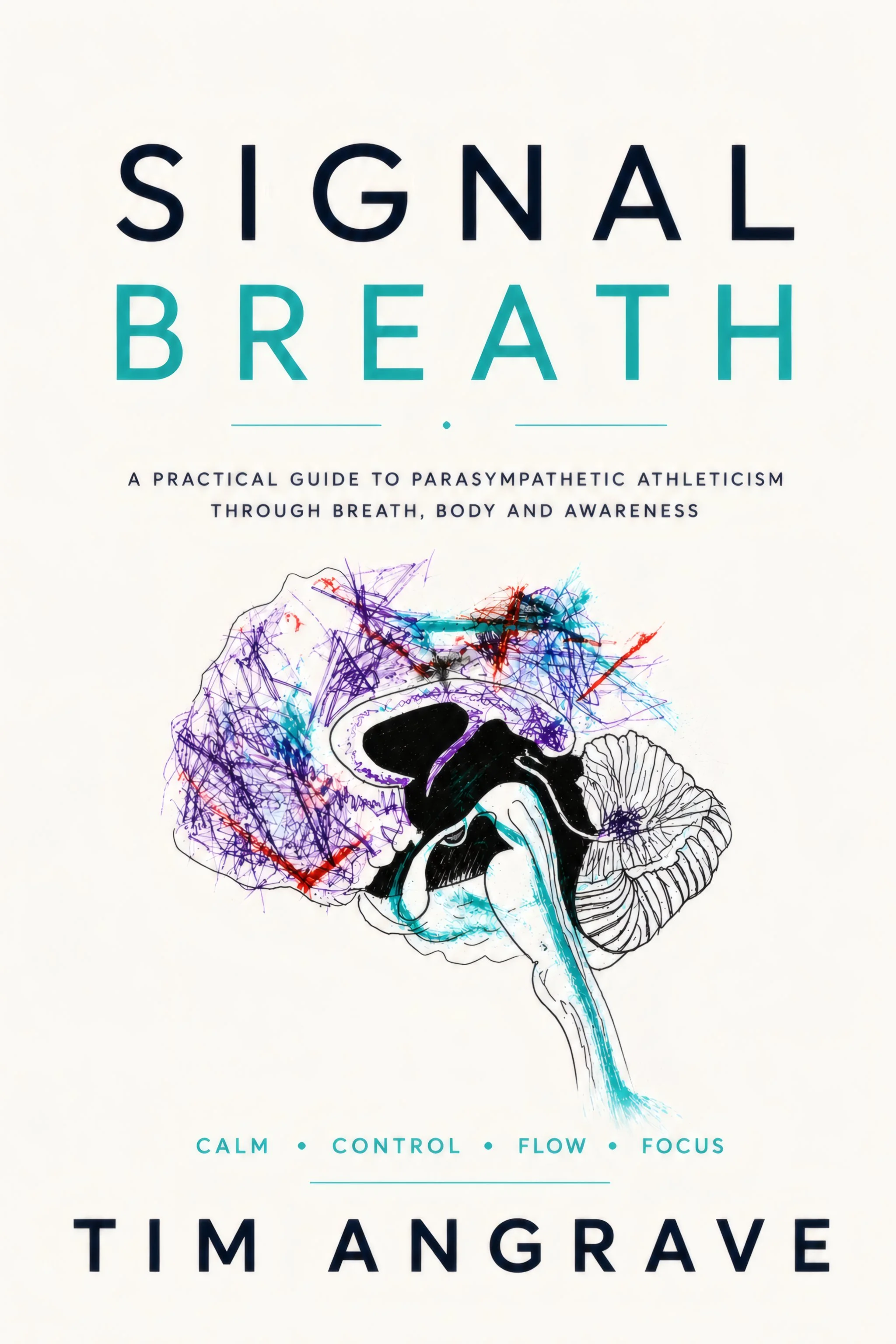
The Signal Breath companion



What if your best performances, clearest decisions and deepest recovery started with one honest breath?
Most of us live with too much noise. The breath gets thin. The jaw clamps shut. The shoulders rise. The body braces for impact, even when nothing is coming.
But there is another channel.
Signal is the moment the breath lands deeper, the shoulders soften, the hands warm and vision widens. You are not escaping life. You are meeting it from a different state.
Signal Breath: Parasympathetic Athleticism introduces a practical, count-free breathing method designed to help you explore that state and bring it into movement, recovery, performance and everyday life.
The method has been tested through injury, recovery, pain, and years of athletic and creative practice.
What You'll Learn
The complete Signal Breath technique and shorter versions for everyday situations
How to encourage calm before demanding situations
Breathing approaches for movement, exercise and recovery
Ways to develop greater awareness of your body's signals
Practical approaches to sleep, light, food and gut signals
How sound and music can influence state and attention
A four-week calibration for putting the ideas into practice
Who This Book Is For
Athletes and runners. Coaches and trainers. Clinicians and health professionals. Breathwork practitioners. Musicians and performers. Busy parents.
And anyone curious about what can happen when we stop constantly forcing the body and start listening to it.
Less noise. More signal.
Buy the Book
Signal Breath: Parasympathetic Athleticism is available to Buy Now.
Released 1st October 2026.
About the Author
Tim Angrave is the creator of Signal Breath and host of The Chillout Lounge Mix, one of Apple's long-running music podcasts.
Drawing on decades of experience in movement, breathing, music and performance, he developed Signal Breath through personal experimentation, athletic and creative practice, injury and recovery.
His approach is simple: rather than continually forcing the body towards performance, learn to listen closely enough to recognise when it is ready to move, recover, create or simply become still.
Stay Connected
Further Signal Breath articles, podcasts and resources will be shared here.
I hope Signal Breath becomes a valuable companion in discovering what your own body can tell you when the noise gets quieter.
Less noise. More signal.
Try Signal Breath
Most breathwork I’ve drawn inspiration from focuses heavily on numbers. Four in, four hold, six out, repeat. Signal Breath concentrates on live signals.
And those signals aren’t just breathing urges. They can be:
A gut rumble or digestive release.
A sudden yawn or sigh.
A flicker of boredom or irritation.
Ears popping, blood moving through the neck or skull.
A pain shift - ache loosening, tightness sliding somewhere else.
A pulse in your lips, toes, or temples.
A subtle drop in thought-speed, or a widening of your gaze.
The moment one of these shows up, you’ve found the signal: Signal Breath is listening, not forcing.
The Master System (with signals first)
Ramp (quick nose in, mouth relaxed out)
Repeat until a clear shift lands - warmer, lighter, gaze widening, pulse softening.
Deep nasal inhale
Fill comfortably full.
Mini exhale hold (to first honest signal)
Let a little air out the nose, then hold until the first strong signal arrives (urge to breathe, gut wave, pulse drop, pain release - whichever comes first).
Full inhale hold (to first honest signal)
Deep nasal breath in; hold again to the first honest signal.
Sharp nasal exhale hold (to first change)
Let it out cleanly; focus internally, totally relax until something changes.
Gentle recovery
Quiet, regular nose breaths starting with a few nasal exhales deep from the throat, then natural breaths. This is the important bit: the body integrates here. A perfect time to meditate, soften the eyes, notice jaw/hands/gut, and let the system settle itself. Go about your day as soon as the system feels reset.
That’s the art: you don’t chase minutes or seconds. You chase body truth. Signals beat seconds; recovery seals the change.
(Optional: if a particular area becomes noticeable during the initial exhale hold, you can tense or engage that same area on the following inhale. This can bring even more focus and energy towards the signal. Don’t search for it - simply follow what the body has shown you.)
Keep it gentle
Signal Breath is not a maximal breath-hold exercise.
Practise somewhere safe, keep the holds comfortable, and never use breath holds while driving, cycling, swimming, in water or at height.
Why this matters for your health
Higher HRV and a heart rate that settles efficiently are signs of something valuable: a body that can respond when necessary and return to recovery when the demand has passed.
When your heart rate settles while healthy variation between heartbeats increases, your cardiovascular and nervous systems are showing greater flexibility with less unnecessary activation. In everyday life, that may mean feeling calmer without feeling flat, recovering more quickly after stress or exertion, resting and sleeping more easily, and carrying less physiological strain into the rest of your day.
Signal Breath is designed to train this return to recovery. It helps your body recognise a more efficient state and become better at finding its way back there.
That recovery capacity matters because a body that spends less time stuck in overdrive has more capacity for movement, concentration, digestion, sleep and the activities that make life feel worth living.
Results
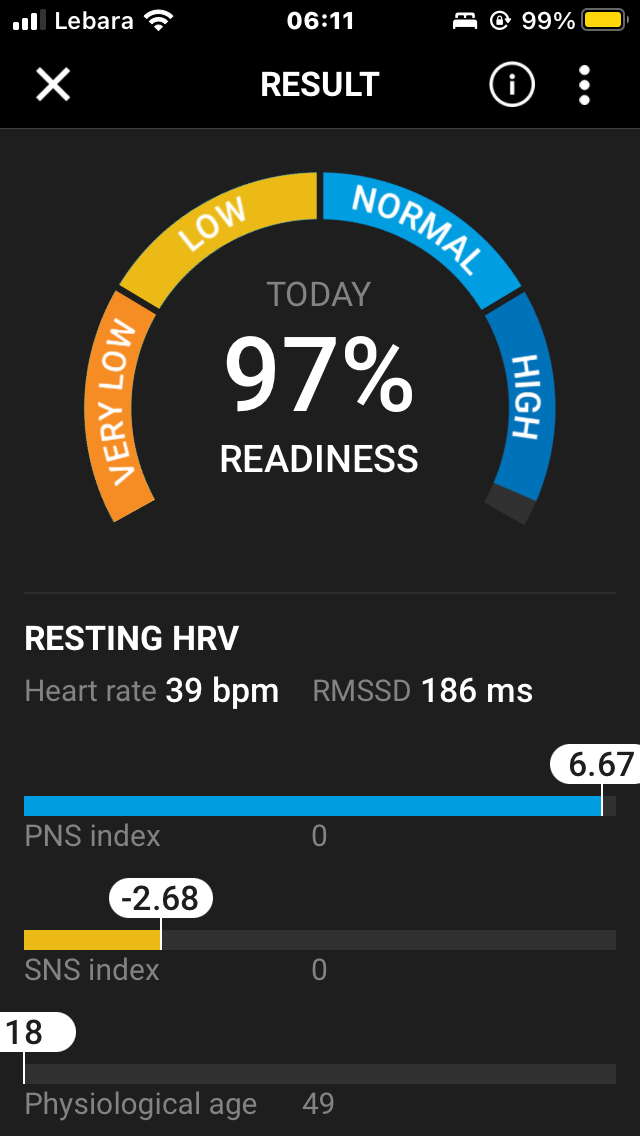
To see whether this return to recovery could be measured, I began tracking heart-rate variability, or HRV, while developing Signal Breath.
HRV looks at the changing intervals between heartbeats. It is an important marker of autonomic regulation, giving us a window into how dynamically the body is adapting, recovering and regulating itself.
The image shows my peak measurement following Signal Breath: RMSSD 186 ms, with a resting heart rate of 39 bpm.
Across repeated experiments, my mum has also recorded similarly high RMSSD readings alongside a reduced heart rate following Signal Breath. Two very different people, at very different stages of life, showing a remarkably similar pattern.
What if the body already knows how to move towards balance, and Signal Breath simply helps us learn how to listen?
Signal Breath:
What It Is - and Why I Think It Matters
What happens when we stop forcing the body and start listening to it?
Most breathing techniques are based on instructions from outside the body and set patterns:
Signal Breath works differently.
The breathing has a loose structure, but the important moments are guided by signals from the body rather than a stopwatch.
A gut pulse might tell me that the opening breathing has done enough. During an inhale hold, I often feel a yawn that tells me it is time to switch to the next step. Another breath may bring a sensation around the chest, throat or elsewhere in the body. Sometimes the natural response is to stretch especially on the breath in.
The point is not to hold the breath for as long as possible.
There is no competition.
It is about learning to notice what the body is doing and allowing those signals to help guide what happens next.
More dynamic than simple relaxation
One of the most interesting things I have discovered during Signal Breath is that my heart does not simply become slower and slower throughout the practice.
The pattern is much more dynamic.
During the initial quicker breathing, my heart rate remains surprisingly low.
During the inhalation hold, it briefly rises dramatically.
Later, during the relaxed exhale hold, my heart rate falls to its lowest point and it feels the most relaxed.
So Signal Breath appears to move me through different cardiovascular states while I remain physically relaxed.
That made me wonder whether the benefit might involve more than simply “calming down”.
Perhaps part of what is being practised is not simply relaxation, but the ability to change or even exercise physiological state and then recover efficiently.
Can responsiveness itself be trained?
This is the question that fascinates me most.
If two such different people can arrive at such a similar pattern, is responsiveness itself something that can be trained?
Perhaps repeated practice can improve autonomic responsiveness: the nervous system's ability to change state and recover efficiently.
For me, training means these shifts become easier, more repeatable and require less intervention over time.
Training while relaxed?
Exercise works partly because we challenge the body and then allow it to recover.
Signal Breath obviously cannot replace physical exercise. Sitting in a chair will not build muscle, strengthen bones or provide all the cardiovascular and metabolic effects of running, cycling or resistance training.
But cardiovascular fitness and aspects of autonomic regulation are also adaptable with repeated training and experience.
During Signal Breath, respiration changes, heart rate changes, pressure within the chest changes, and the body continually adjusts.
So I am interested in another question:
Can some aspects of cardiovascular and autonomic regulation be meaningfully trained while the body itself remains largely relaxed?
The numbers are only part of it
HRV is useful because it gives me something objective to measure.
I see it as one important stream of information alongside heart rate, recovery, physical sensation and how I actually feel.
But it does not tell the whole story.
Signal Breath can make ordinarily automatic sensations suddenly noticeable: the pulse of the heart, movement around the abdomen, changes around the chest and throat, sensations through the back and neck, spontaneous stretching, warmth, relaxation or a feeling that different areas of the body are communicating more clearly.
These sensations matter.
After all, the purpose of Signal Breath isn't just to create an impressive graph.
It is to change how a human being feels and functions.
Sometimes I have woken feeling extraordinarily well despite an HRV reading being lower than the previous day.
That has reminded me not to confuse the measurement with the person.
Learning your own signals
One of the most powerful parts of Signal Breath is learning to listen.
The body is communicating all the time, but much of that information is easy to miss when attention is constantly pulled outward. A change in warmth, pressure, pulse, vision, tension, gut sensation or the simple urge to breathe can become meaningful when you stop trying to force an outcome and start noticing what is actually happening.
This is close to what science calls interoception - our ability to sense the internal state of the body.
Signal Breath turns that awareness into a practice.
You are not trying to hunt for a particular sensation or recreate yesterday’s response. You are learning the language of your own system, one honest signal at a time.
Over time, that may become one of the deeper skills of the method:
Less guessing, less forcing, more listening.
The breath becomes a way of asking a question.
The body gives the answer.
And perhaps, with practice, that conversation becomes more automatic. What begins as conscious listening may gradually become something the body and mind recognise and respond to without so much deliberate effort. The signals become more familiar, the response more natural, and regulation begins to feel less like something you do and more like something the system remembers.
Where exercise fits
Physical exercise is part of my own puzzle too.
When I return to regular training, my HRV often changes substantially. Harder aerobic work can temporarily lower my morning readings, only for stronger readings to appear later during recovery.
Signal Breath can still produce large changes even on those lower mornings.
So I am now tracking:
Exercise → Recovery → Baseline HRV → Signal Breath response
I think health works as a system.
Movement, sleep, hydration, food, recovery, daylight, stress and breathing all interact.
This is an ongoing experiment
I have lots of notes, HRV recordings and experiments to organise, including earlier work involving different breathing patterns, exercise, eating, body position and longer breath holds.
I am also now repeating measurements using newer equipment and a more consistent protocol.
That's one reason I want this material on a website rather than permanently fixing every hypothesis inside a book.
I can show what happened.
I can say what I currently think it might mean.
And when better evidence arrives, I can update it.
The possibility
Signal Breath may turn out to be primarily a very effective way of relaxing and paying attention to the body.
But there may be much more going on.
My observations raise questions about:
HRV and autonomic responsiveness
Cardiovascular transitions
Recovery
Interoception
The interaction between breathing and physical training
and whether some aspects of nervous-system regulation can themselves be practised or even exercised.
Those questions are fascinating to me.